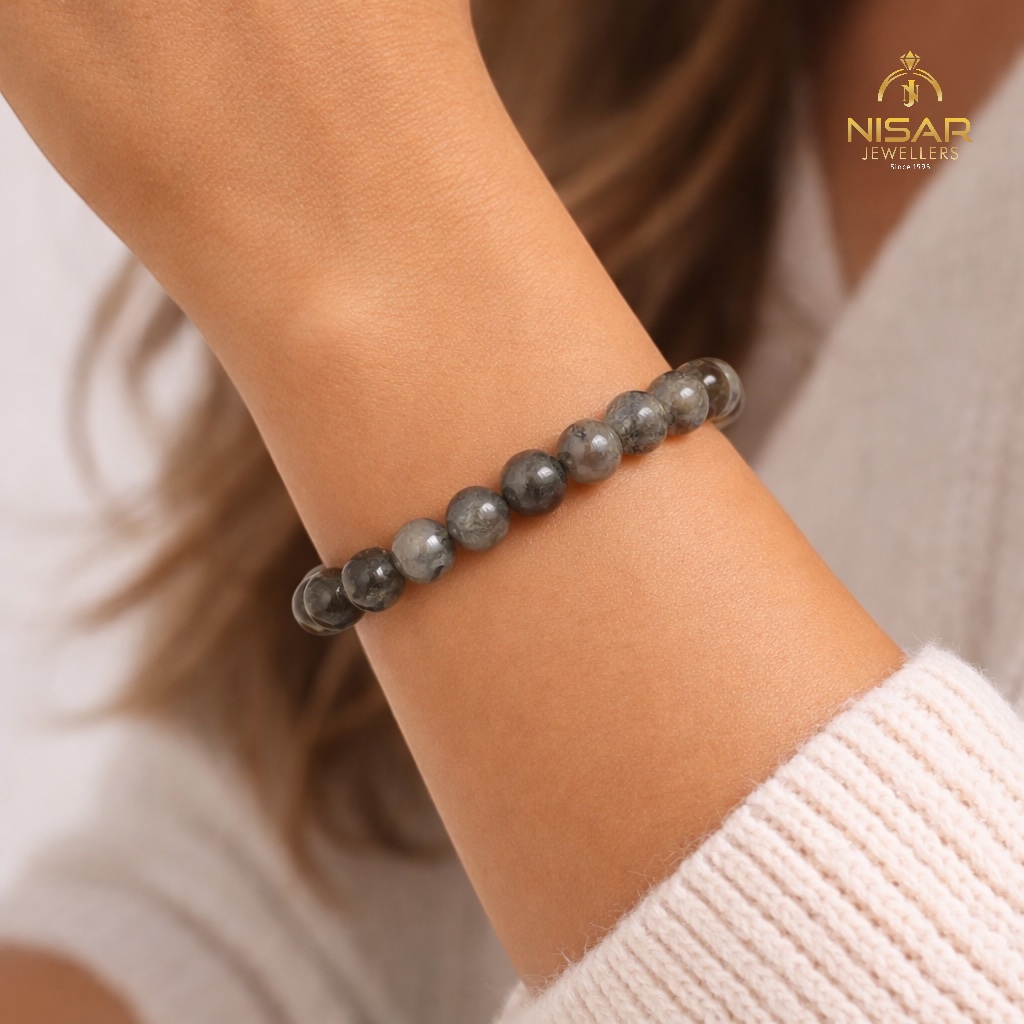


Natural Labradorite Beads Bracelet
Labradorite is a captivating plagioclase feldspar mineral renowned for “labradorescence,” a dazzling iridescent play of blue, green, gold, and violet light caused by internal light refraction. Originally discovered in Labrador, Canada, it is a 6–6.5 on the Mohs scale, often associated with transformation, protection, and spiritual growth.
Key Characteristics and Properties:
- Labradorescence: A unique, metallic optical effect that appears as a vibrant, shimmery play of color when rotated in light.
- Origin: First discovered in 1770 in Labrador, Canada.
- Composition: A sodium-calcium aluminum silicate, specifically a plagioclase feldspar.
- Colors: While often dark grey/black in its rough state, it flashes with blue, green, yellow, and sometimes red or purple.
- Hardness: 6–6.5 on the Mohs scale, suitable for jewelry with proper care.
- Spectrolite: A rare, high-quality, full-spectrum variety of labradorite found in Finland.
Metaphysical and Historical Significance:
- “Frozen Light”: Often associated with the Aurora Borealis in Inuit and First Nations legends.
- Stone of Transformation: Used in spiritual practices to increase consciousness, intuition, and provide protection for the aura.
- Healing Properties: Thought to balance energy and reduce stress, often used in meditation or as a protective talisman.
Uses and Care:
- Jewelry: Popular in rings, pendants, and bracelets due to its striking, unique, and often affordable nature.
- Care: Sensitive to heat and chemicals, so it should be cleaned with warm, soapy water and protected from scratches.
- Versatility: Beyond jewelry, it is used as decorative polished stones and in metaphysical healing practices.
- Labradorite is found worldwide, including in Canada, Madagascar, Russia, and the United States
Be the first to review “Natural Labradorite Beads Bracelet”
Related products


Out of stock
Gemstone Jewellery
₨2,500.00

Ear Accessories
₨12,000.00


Gemstone Jewellery
₨3,200.00


Out of stock
Gemstone Jewellery
₨2,200.00


Gemstone Jewellery
₨12,000.00


Gemstone Jewellery
₨3,500.00


Gemstone Jewellery
₨12,000.00


Out of stock
Gemstone Jewellery
₨4,000.00
Reviews
There are no reviews yet.